Maniac Stuff
Maniac Stuff
We're at the twenty-ninth letter, and I think it's time I confessed something.
I have a maniac's habit.
But before I tell you about it, I need to explain a concept. It's the one that closes the argument of last week's letter, so if you haven't read it, I suggest you read it here.
Intention and attention
They are two words that sound alike, but they do two different jobs.
Intention is what I want to achieve. It's the goal.
Attention is the way I get there. Where I look, what I notice, what I do every day.
And one without the other is useless. Intention without attention is a dream: you know where you want to go, but you never look at it. Attention without intention is restlessness: you look at everything, you run everywhere, and you go nowhere.
The point is that you don't have to hold them in mind with willpower. When you write the goal, and underneath it the way to get there, and you wrote it yourself, by hand, something happens: you plant it in your brain. Then you reread it now and then, if you feel like it. And then you can even forget about it.
Because at that point the unconscious takes over. Every day, without you asking, your attention goes on its own towards those things. You notice the opportunity you didn't see before. You spot the right person in the room. You remember the ten minutes before sleeping. And what looked impossible on paper slowly starts to become possible.
This mechanism has a name, selective attention, and it deserves a letter of its own: I'll write it next time. But if you read last week's letter, you've already seen it at work. Remember the loop? What you think decides what you notice. What you notice decides how you feel. And how you feel decides what you do.
Last week I showed you the loop when it turns against you. Today I'll show you how to make it turn in your favour. If you choose the information you put in your head, what you notice changes, how you feel changes, and how you act changes completely.
That's where intention and attention work together. And the direction you're heading in is the one you chose, because you wrote it.
My maniac's habit
And here it is, my maniac's habit: the review of my month.
Every month, on the first day, I write down what I want to achieve. And on the last day I sit down and put my month on trial. Not a sunset reflection with herbal tea. A real trial, with a written record, always with the same questions.
It's how I plant intentions and train attention. I've just finished it for October, and I'll show you the sheets.
There are two. The one for the first day, and the one for the last.
The first-day sheet
I split my life into three areas: personal, work and money.
For each area I write two or three goals. No more. If you write ten, at the end of the month you'll have done two and you'll feel like a failure. If you write three, you do them.
Every goal has a number and a date. Not "work out more", but "four workouts a week". Because a goal without a number can't be judged, and if you can't judge it, at the end of the month you're always right.
But the most important part isn't the goal. It's what I write underneath.
The action. What I actually do to get there.
"Two books read by the thirtieth" is a goal. On its own nothing happens: the twenty-eighth arrives and you realise you're on page forty. "Ten minutes every night, before sleeping" is an action. That one you can do tonight.
"Four workouts a week" is a goal. "Monday, Wednesday, Friday and Saturday at seven, already in the calendar" is an action. You don't have to decide every morning whether to go. You already decided on the first of the month.
The goal says where you want to get. The action says what you do tomorrow morning. And almost everyone writes only the first half.
Then there's one last box, different from the others. It doesn't say what I need to achieve. It says who I need to be. One or two behaviours, no more. And there too, each with its action.
Mine, for November, is to be truly present in the meetings that matter. I noticed that I often show up to an appointment thinking "and now what do we talk about for an hour?", and while the other person talks I'm thinking about my answer instead of listening. The action is small: one minute before every meeting, I ask myself what I want to say. Not what they want to hear.
The sheet looks more or less like this:
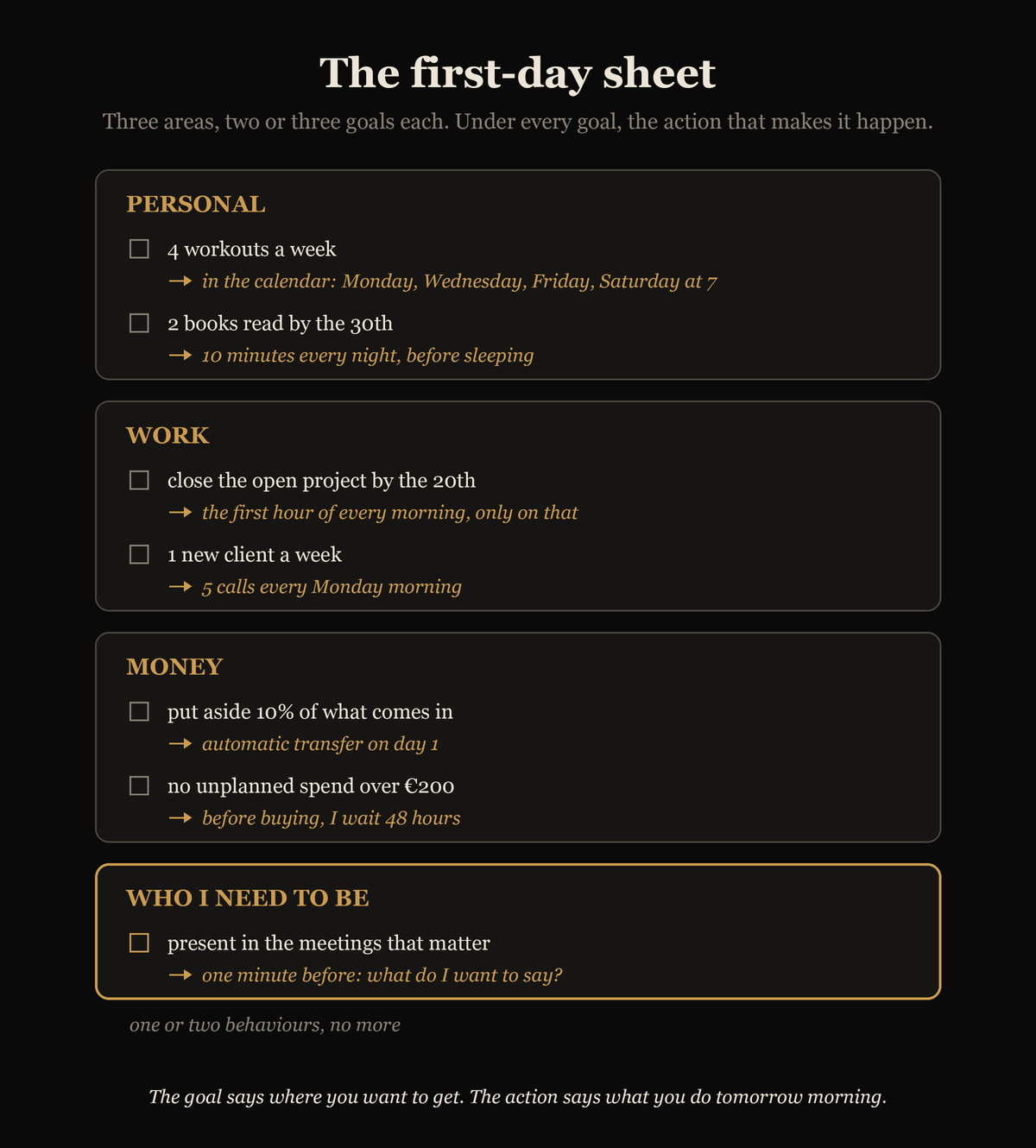
The examples are made up, yours will be different. What matters is the shape: three areas, few goals, and under each one the action.
The last-day sheet
At the end of the month I take the first-day sheet, line by line, and for every goal I answer four questions.
What was the goal? How did it go: yes, no, half? Why? And what do I change next month?
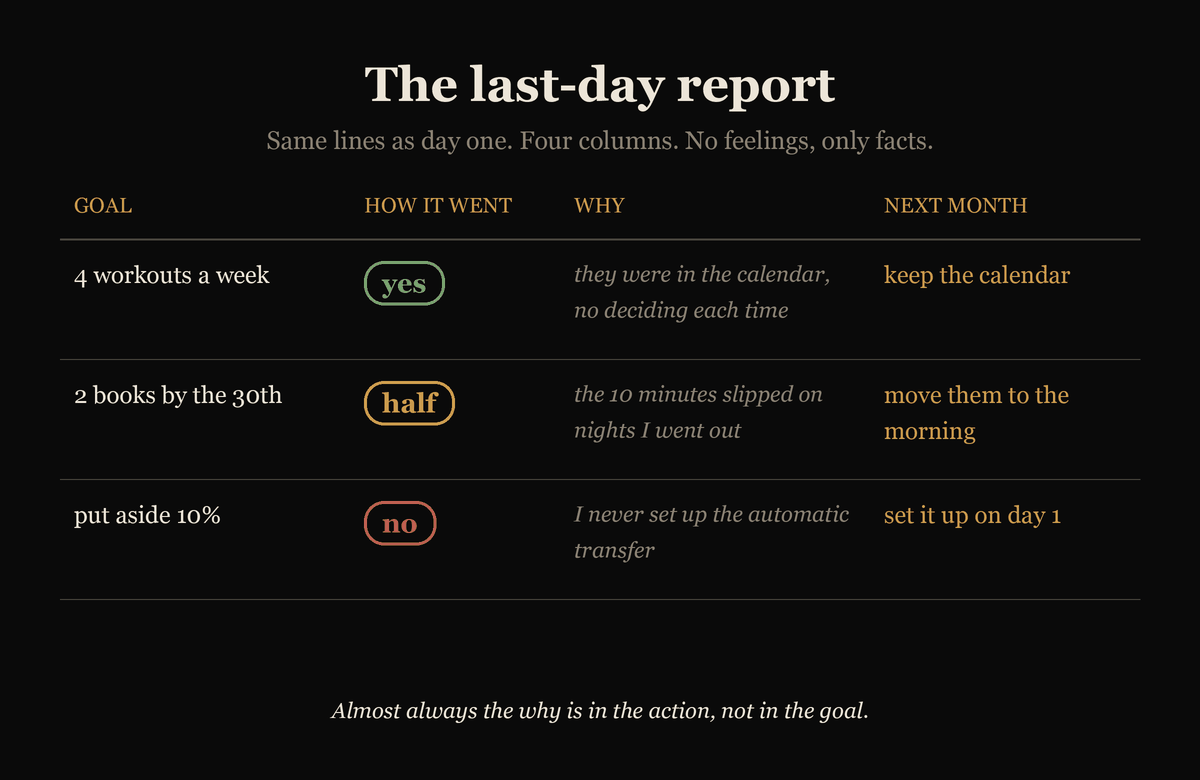
The column that hurts is the why. And "I didn't have time" doesn't count. I had the time, I put it somewhere else. I have to write down where.
And look at one thing in the examples: almost always the why is in the action, not in the goal. The two books didn't slip because reading was too hard. They slipped because the ten minutes at night disappeared every time I went out. So next month I don't change the goal. I change the action: I move them to the morning.
The column almost everyone skips is the last one, next month. We have big reflections, we understand deep things, and then the next month we start over exactly the same. Understanding changes nothing. Only what you understand and then write on next month's sheet changes something.
My October
I'll tell you straight: on the numbers, I didn't win October. Out of six goals I brought home two and a half.
And my first reaction, I admit, was to defend myself. "But I built a lot." "But the things that matter got started." Which was true, by the way.
But that's exactly where the record is needed. Both things are true, and they have to be written down separately. October lost on the numbers and won on what I built. If I mix them, I tell myself a comfortable story. If I keep them apart, I know exactly what to fix in November.
Why I do it
Maybe now you're asking me: doesn't it wear you out, analysing everything?
No. What wore me out was before, when things "happened" to me.
Because when you reread your months one after another, you find out that chance almost never exists. The things that looked like bad luck had a reason, and almost always the reason was me. A goal that slips three months in a row isn't bad luck. It's a behaviour I haven't changed yet.
And you discover things you'd never see from the inside. I, for example, found out that I was writing my goals too low. Twice in a row I did much more than I had set. Not because I'm a phenomenon, but because I wrote low to feel safe. To be sure I'd win.
That's a behaviour too. And without the record I would never have seen it.
Before I let you go
I'm not asking you to be a maniac like me. But November has just started, and you can do your first sheet tonight.
Three areas. Two or three goals per area, each with a number. Under each one, the action you'll take tomorrow. And just one behaviour.
And on the thirtieth of November, four columns: goal, how it went, why, next month.
Not to give yourself a grade. To see how much of your month you decided, and how much you left to chance.
If you feel like it, send me your sheet by replying to this email. That way there are two of us who have to stick to it.
Fifty-four attempts to become better.
This is the twenty-ninth.
Best, Stefano.
If you feel like it, reply to this email and tell me. I read every single one, myself.
Fifty-four attempts to become better.
54letter.com