Week 10 of 54 — The Man on the Roof
Week 10 of 54 — The Man on the Roof
I'm writing to you from Buenos Aires, as I mentioned last week.
But this time, I'm staying.
A whole month. Not four days, not a week, not "passing through and then we'll see." A month still in the same place, with the same door I open in the morning, the same corner café, the same sound coming through the window at seven.
It's been a long time since this happened to me.
I arrived from São Paulo a few days ago — and before that from the mountains of India. I wrote to you last week about a music inside that doesn't play (reread it, if you don't remember), and one thing I know about myself is: my music plays in movement. Movement is the way. Stopping means quitting.
Here the seasons are reversed: while summer begins for you, winter is coming here. This thing kills me — but I have to say that experiencing the beginning of winter in June is interesting.
I wake up at seven, open the curtain and the view is always the same: autumn trees, low clouds, a not-at-all beautiful skyline. And a construction site, right down here.
On that construction site, every morning, there's a man. Let me show you.
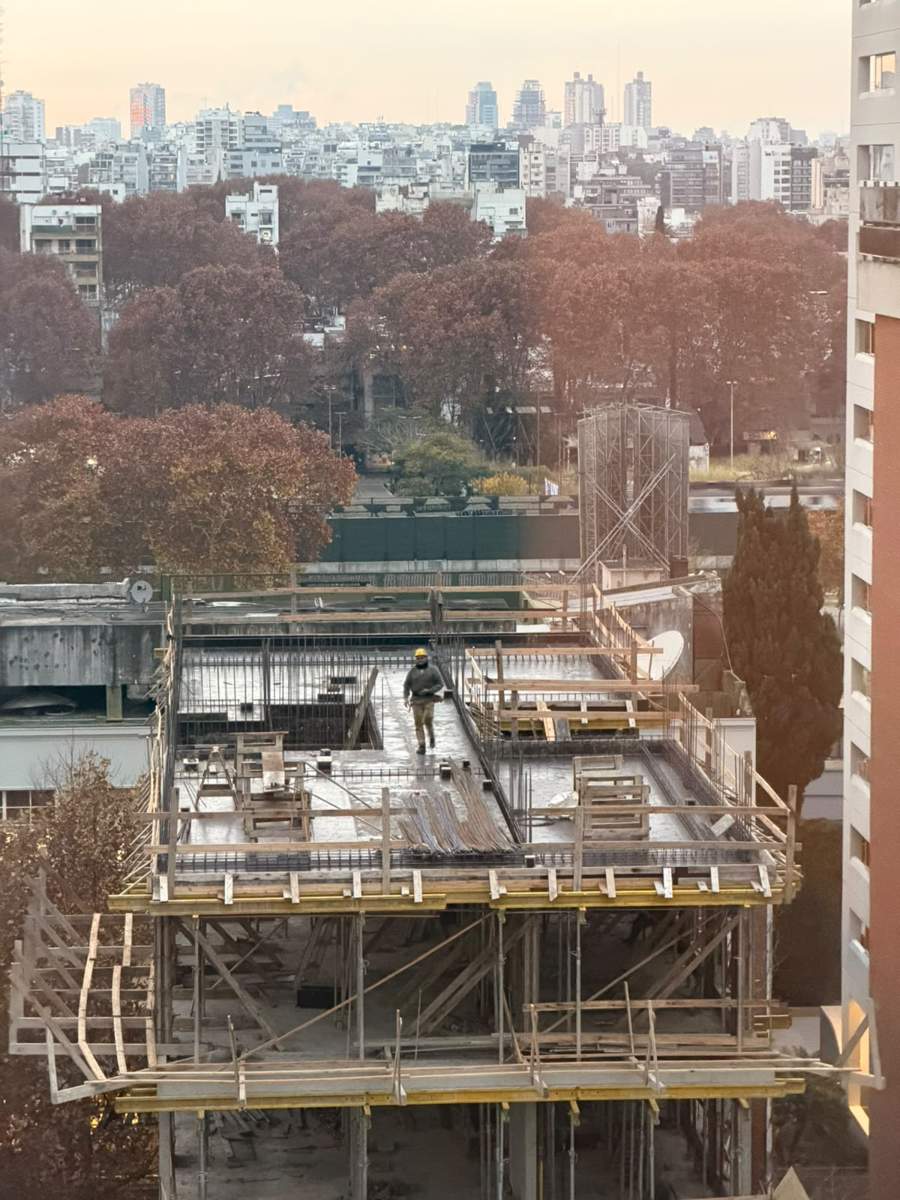
He arrives before all the others. Always. At seven he's already on the roof — the roof of a building that doesn't exist yet, exposed rebar sticking out of concrete, wooden planks, no protection, as if he were immortal.
For the first half hour he's alone, him and the cold. Then the others arrive, but meanwhile he's already started: the blows on the iron rise up to my window while the city, behind him, wakes up calmly.
I watch him. Almost every morning, now. Coffee in hand, a few floors higher, inside a building that someone like him built.
And every morning two things happen inside me.
The first is that I remember.
I remember when I used to do jobs like that. In Galluccio I picked hazelnuts, chestnuts, olives, mowed the lawn ten hours a day — in September, October, back bent for hours, hands that wouldn't close anymore at the end of the day, the dampness of five in the morning that would freeze on you.
Then in the evening I was a waiter. From certain nights I remember the twenty-seventh pizza on my arm and the smile I never lost even for a second.
Yet, I confess: I felt like such an asshole.
I put the chestnut money aside. Not to buy myself something.
To leave, to travel.
So when I see him up there, at seven, in the cold, a part of me isn't looking at him.
It's looking back.
The second thing is less noble. And I'm writing it to you anyway, because this letter only makes sense if I also put in the things I'm not proud of.
I look at him and think: he lives blind.
Blind because I wonder if he knows he could be something else. If this job really fulfills him, or if he ended up in it — children who came too early, a family to support, and this was the only thing he could do. Or maybe he comes from a nearby country, from a poverty that never left him time to ask himself anything, and for him being on that roof, in Buenos Aires, is already a destination. Maybe, where he comes from, that up there is a status.
Or maybe he's at the beginning of a story I don't know. In my family there's a relative who left Italy for America to be a gas station attendant: he ended up buying the gas station, opening an auto shop and six luxury dealerships, he's my example to follow.
Maybe this man in thirty years will be the owner of the construction site. Or maybe in thirty years he'll be on the same roof, just slower.
I wonder which of the many realities that exist he belongs to, and in my mind I remember and imagine all the steps he has to face to change his personality and reach the next stage of the Matrix.
Because I did it, I was down there.
And it kills me to think that maybe he doesn't even know, doesn't know that everything is possible in this life, that anyone can find the happiness and beauty of things.
And it's not the first time I do this. I've been doing it for years.
With anyone who does those jobs that, whether you want it or not, have nothing noble about them — except the pain and sacrifice of what they hide.
I wrote to you last week about a music we keep inside. Here it is: I look at him and wonder if he has it, if he'll never play it, or if he's playing it right there, every morning at seven, with hammer blows on iron — and I'm the one who can't hear it.
Then, every morning, comes the moment when the reasoning turns against me.
Because the truth is there's no answer. And because the blind one, when I make these reasonings, is me.
I know nothing about that man.
I don't know if he goes home in the evening and hugs his children. I don't know if he laughs at dinner, if he sleeps all night without noise in his head. Maybe he's ten thousand times happier than me — than me who's been moving for years and can't find a minute to stop, who looks at him from above and calls him blind while I'm the one who, from this window, can't see shit except the next goal to conquer.
Last summer, in Dublin, during a solitary dinner — as always �� I wrote a sentence in my diary that today I have trouble rereading:
▎ Even so, nothing is enough for me.
Nothing is enough for me. That's what's written, black on white, in my handwriting. While he, down there, beats one iron after another and — for all I know — it's enough for him.
For years I thought that "starting to see" meant changing place, changing life, changing skin — I did it, everything, multiple times.
The more I grow, the more I start to suspect something else.
▎ Maybe you can't break out of the Matrix. Maybe getting out is just this: knowing who you are, accepting it, and living happily with what you have.
I write it and it's so easy. Doing it, I haven't succeeded yet. And I know I never will.
And I also know I haven't succeeded because I had already written it. January last year, Barcelona, alone in front of a pizza I didn't want.
That evening in my diary I wrote: "I need to learn to appreciate the things I have. Not tomorrow, not when I've done something else. Now, here."
A year and a half later I'm an ocean away, watching a worker from a window, with the exact same sentence still to learn.
Maybe the man on the roof has already learned it. Maybe not. I'll never know, and that's okay: tomorrow morning he'll be up there first again, and I'll be here again watching him, with the coffee getting cold.
I want to close with the question that remains in my hand every morning, when he starts beating the iron and I open the laptop.
Is it right to settle, or should you fight by always raising the standards?
I have my answer. But I'll tell you about it later.
Fifty-four attempts to become better.
This is the tenth.
Best, Stefano.
Know that I'm rooting for you, whatever roof you're on.
Until next week.
Fifty-four attempts to become better.
54letter.com